
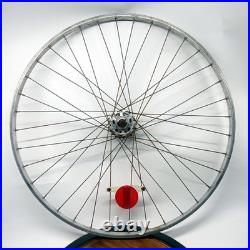
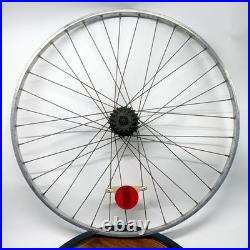
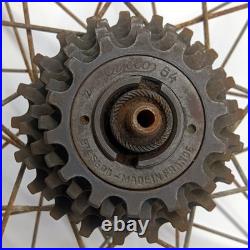
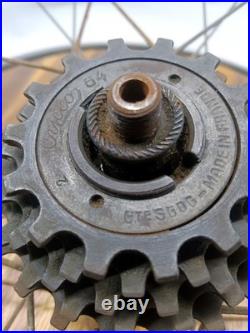
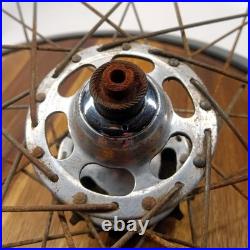
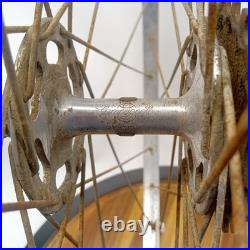
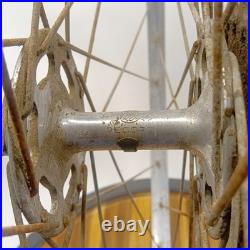
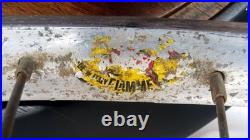
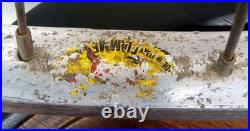
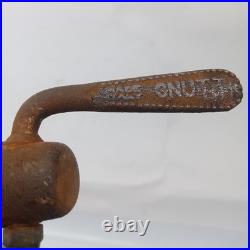
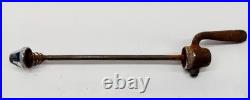
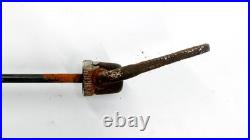
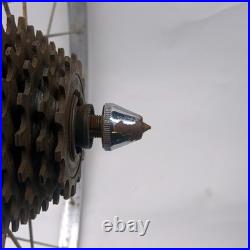
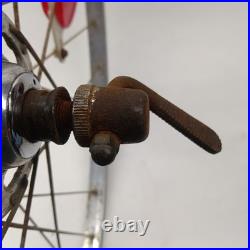
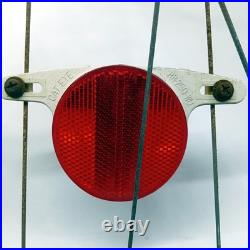
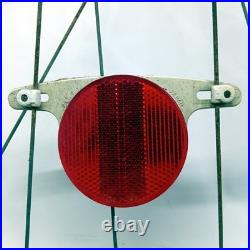

Gnutti rear skewer with flat handle. Fiamme rim (possibly not authentic Fiamme). Cat Eye RR-250-WU reflector. The price is a guideline, but I’m not set on it. Please send an offer you feel is fair! This wheel seems to be made from 1964 parts all around (see the notes later on for the research on this). The original owner rode this in 1972. Cyclo Freewheel Bré SGDG marking – This is a French patent mark, which was no longer used after 1968. Cyclo 64 marking – This is a date-stamped mark for the year of manufacture (1964). 14/15/17/18/19T Campagnolo Record hub high-flange 36h date? There no date on the lock nut on the hub axle. Marked “Made in Italy”. Cone end flat bar – This style bar was banned after 1978. Only one spring, and it will need disassembly and cleaning to make it work correctly. Rim 3-color label design – yellow label, red Pegasus, black writing date: produced early 1960s to 1975 Yellow label design – The yellow label designated a shorter rim–and was lighter overall–than the red label. It was designed for road bikes. A note about the rim: The spoke nipples are not recessed, and there is no “Fiamme Made in Italy” engraving on the rim itself. Both clues indicate that the rim may have been replaced and a Fiamme sticker put on it, which apparently happened a bit in those days. But I also cannot find evidence of Fiamme ever printing a yellow label with a red Pegasus, which may mean manufacturing was licensed to another company; or it could be an early version before the engineering was finalized. Any thoughts on this are welcome… One of the plastic nuts is weak. Produced aluminium clincher rims that were designated with a yellow marquise-shaped label with the resurrected Pegasus logo… With clincher tires and Schrader valves that could be’pumped up’ at any local gas station. Online reports suggest these Fiamme clincher rims were in production until approx. ” “The yellow label rims (oval shape label) were of a lighter weight approx. 50-60g and were also available in both road… And pista profiles for special events, time trials and/or lighter riders. ” – condorino (dot com) /2017/12/30/s-a-fiamme-of-milano/ “Breveté SGDG was a a form of French patent that ceased to exist in 1968. The name was a common abbreviation for Breveté Sans Garantie Du Gouvernement. Pre-CPSC levers had a straight lever at one end, and a simple conical-shaped nut at the other end. Post-CPSC levers were curved, while the nut end was rounded nearly to a ball-shape. I have no doubt that many lives were saved because of the change. Blogspot (dot com) /2014/02/classic-components-campagnolo-record. Html “The word “Record” is added to the hub barrels and open “C” on quick release lever changed to closed “C. ” “The lock nut on the hub axle typically is stamped with CAM. 60 or some other number denoting the last two digits of the year of manufacture. Velo-retro (dot com) /tline. Notes from -sscycleworks (dot com) /components/freewheels-Cyclo-french-thread. Html Cyclo freewheel was a British company that split in two due to import restrictions. This freewheel was made in France. The pictures show cursive for early models. San serif fonts were used on later models. First year models did not have a date after the logo, so the date stamp is likely accurate. For this freewheel, both cursive _and_ the date stamp was used, which must have lasted only a couple of years. Since the French and British have the same origin, check that the smallest sprocket is not part of the freewheel body. British Cyclo freewheels were different — all the sprockets screwed on from the left except the smallest — and quickest wearing — one! This sprocket was integral with the freewheel body and could not be removed. Mechanics who didn’t know this have broken teeth off this sprocket trying to remove it. Sheldonbrown (dot com) /freewheels.